
Market
When should I drop my price? It depends where you host
Booking lead time swings 50x by market.
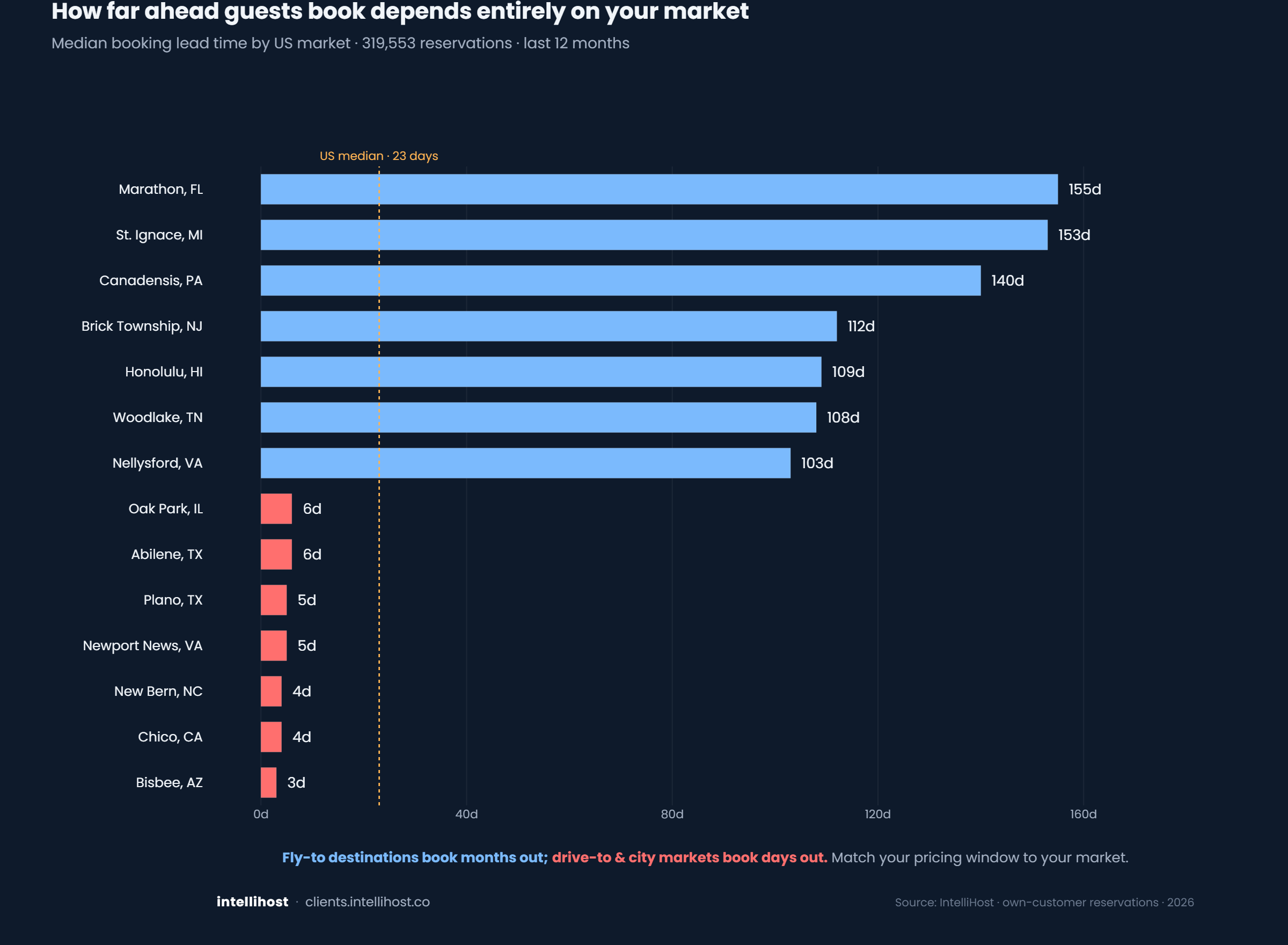
3 to 155 days
Based on
319,553 reservations
Key finding: Across 319,553 reservations, median booking lead time ranges from 3 days in drive-to and city markets to 155 days in fly-to destinations, a 50x swing that depends almost entirely on your market.
The short version
There is no universal answer to when you should discount unsold nights. How far ahead your guests book is set mostly by where you host, not by the calendar month. A generic “drop your price 14 days out” rule works against you if your guests book a week ahead or five months ahead. Match your pricing to your own booking window instead.
The data
We looked at median booking lead time, the number of days between when a guest books and when they check in.
- In drive-to and city markets, the median guest books about 3 days ahead.
- In fly-to destinations, the median guest books about 155 days ahead.
- That is a 50x spread between the two ends of the range.
- The finding is drawn from 319,553 reservations.
Why it works
Booking lead time reflects how people plan a trip. A weekend guest driving to a nearby city decides late and books late, so demand for a given night shows up only days before check-in. A guest flying to a beach or ski destination books flights, time off, and a place to stay months in advance, so demand for the same night arrives far earlier. Your pricing lever, the choice to hold firm or discount an open night, only pays off if it fires when your guests are actually shopping. A market’s typical lead time tells you when that shopping happens.
What to actually do
- Find your own median booking lead time from your reservation history rather than assuming a national average.
- If your guests book close in, keep prices firm until the last stretch, then use last-minute discounts to fill the final open nights.
- If your guests book far ahead, price and adjust your calendar months out, and treat a still-open night near check-in as a signal you priced too high earlier, not a routine discount moment.
The honest caveats
This is a correlational finding. It shows that lead time varies enormously by market, and it points to matching your pricing timing to that window. It does not prove that any specific discount schedule raises revenue, and it does not measure the size of that effect. The 3-to-155-day range describes the ends of the spread across markets, not a target for any single property. Your own market and property may sit anywhere in between.
Methodology
The finding is based on 319,553 reservations, sourced from IntelliHost and Key Data in 2026. We measured booking lead time as the number of days between the booking date and the check-in date, then took the median within each market. Comparing medians rather than averages keeps a handful of very-early or very-late bookings from distorting the picture. The 3-to-155-day range reflects the difference between the shortest-window markets, drive-to and city, and the longest-window fly-to destinations.
Frequently asked questions
When should I drop my price on unsold nights?
It depends on your market’s booking window, which ranges from a 3-day median in drive-to and city markets to 155 days in fly-to destinations. In short-window markets, discount only in the final days before check-in. In long-window markets, get your pricing right months ahead.
Why do some hosts book months in advance while others fill up last minute?
Because trip planning differs by destination type. Fly-to guests book flights and time off early, pushing their median lead time toward 155 days, while drive-to and city guests decide late and book around 3 days out.
Does a generic last-minute discount rule work everywhere?
No. With booking lead time swinging 50x across markets, a single calendar-based discount rule will misfire in most of them. Base your timing on your own median lead time instead.