
Market
When guests actually search
The shopping happens late.
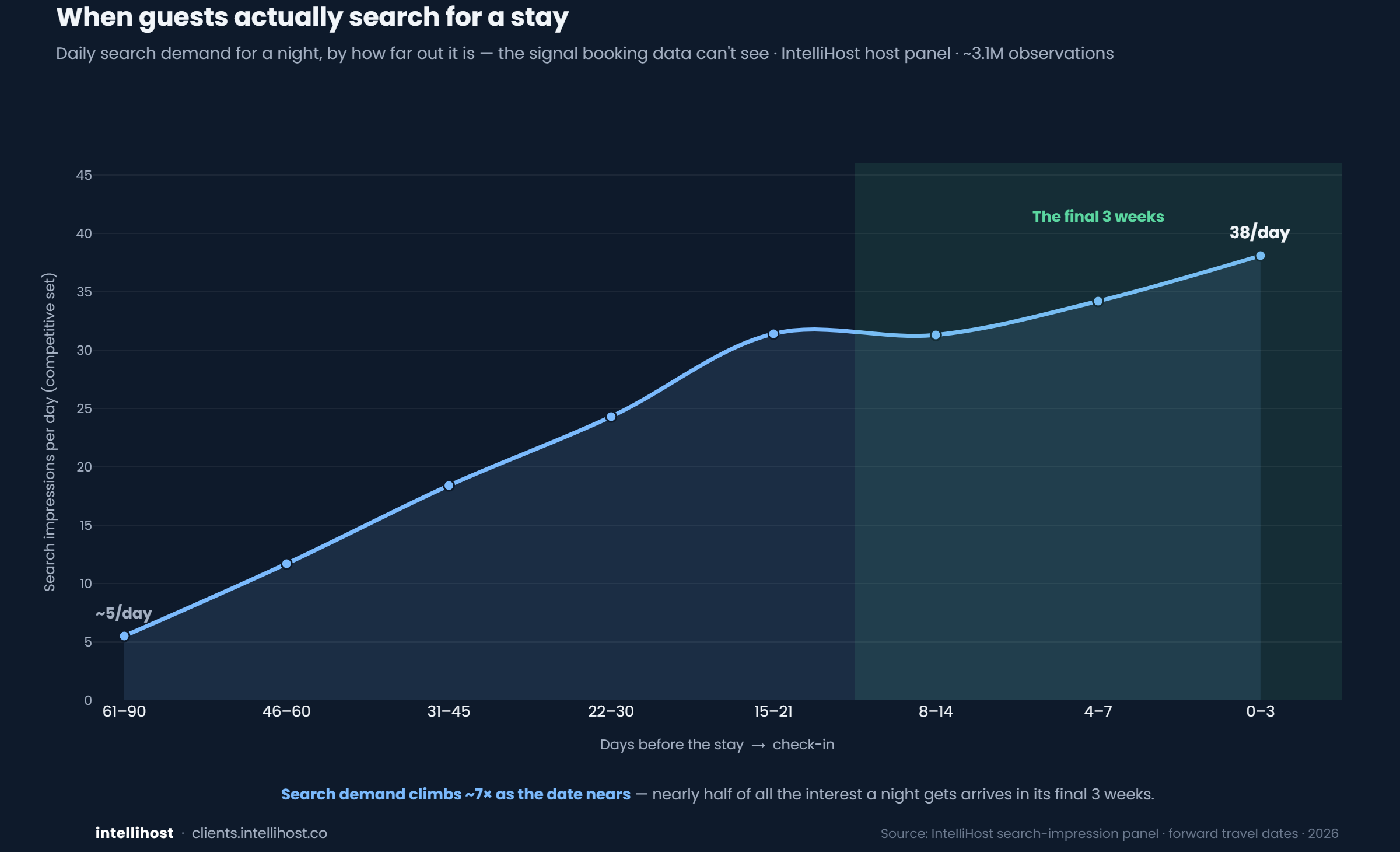
47% of demand in the final 3 weeks
Based on
3.1M observations
Key finding: About 47% of all the search interest a given night ever receives arrives in its final three weeks, and 18% of it lands in the final week.
The short version
Guests shop late. Demand for a night is not spread evenly across the calendar. It builds toward the stay date and peaks close to it. If your pricing tool reacts to bookings that already happened, it is looking backward while the real demand is still forming. The move is to price into that late wave, not before it.
The data
Using our search panel, we tracked forward demand for individual nights over time. A few numbers stand out:
- Forward demand for a night rises roughly 7x as the stay approaches.
- About 47% of all the search interest a night ever gets arrives in its final three weeks.
- About 18% of that interest arrives in the final week alone.
Demand is back-loaded toward the stay date. That is the whole story in one line.
Why it works
Travel decisions firm up close to the trip. Plans that were vague become concrete, dates lock in, and searchers turn into bookers. That is why search interest for a night keeps climbing right up until the stay. Most pricing systems work off realized bookings, which means they only see demand after it has converted. They are blind to the interest still building. By the time the booking data reacts, the wave has already crested.
What to actually do
- Keep pricing flexibility in the final three weeks. Do not lock your rate a month out and walk away.
- Watch live search and view signals for near-term nights, not just confirmed bookings.
- Adjust into the wave. If a near night is still open inside three weeks, treat that window as your prime chance to capture demand, not a lost cause.
The honest caveats
This is a correlational finding about when search interest arrives, not a controlled test of what a given pricing move earns. It describes the shape of demand across a large panel. It does not prove that any single adjustment will lift your revenue by a set amount. Patterns vary by market, season, and property type. Use this as a timing lens, then verify against your own calendar before making big changes.
Methodology
The finding is based on 3.1M observations from the IntelliHost and Key Data search panel, measured in 2026. We tracked forward search demand for individual nights over time as each stay date approached, which lets us see when interest arrives rather than only when a booking closes. The concentration figures describe the share of a night’s total search interest that lands in its final three weeks and its final week.
Frequently asked questions
When do most guests actually search for a stay?
Late. About 47% of all the search interest a night receives arrives in its final three weeks, and 18% in the final week. Demand builds toward the stay date rather than spreading evenly.
Why do booking-based pricing tools miss this?
They react to bookings that already happened, so they only see demand after it converts. The late surge in search interest is invisible to them until it is over.
Should I lower my price a month out to fill a night?
Not automatically. Since roughly 47% of interest arrives in the final three weeks, an open near-term night often still has strong demand coming. Keep your rate flexible and adjust into that window instead of discounting early.