
Operations
Two completely different businesses
Same revenue, opposite operation.
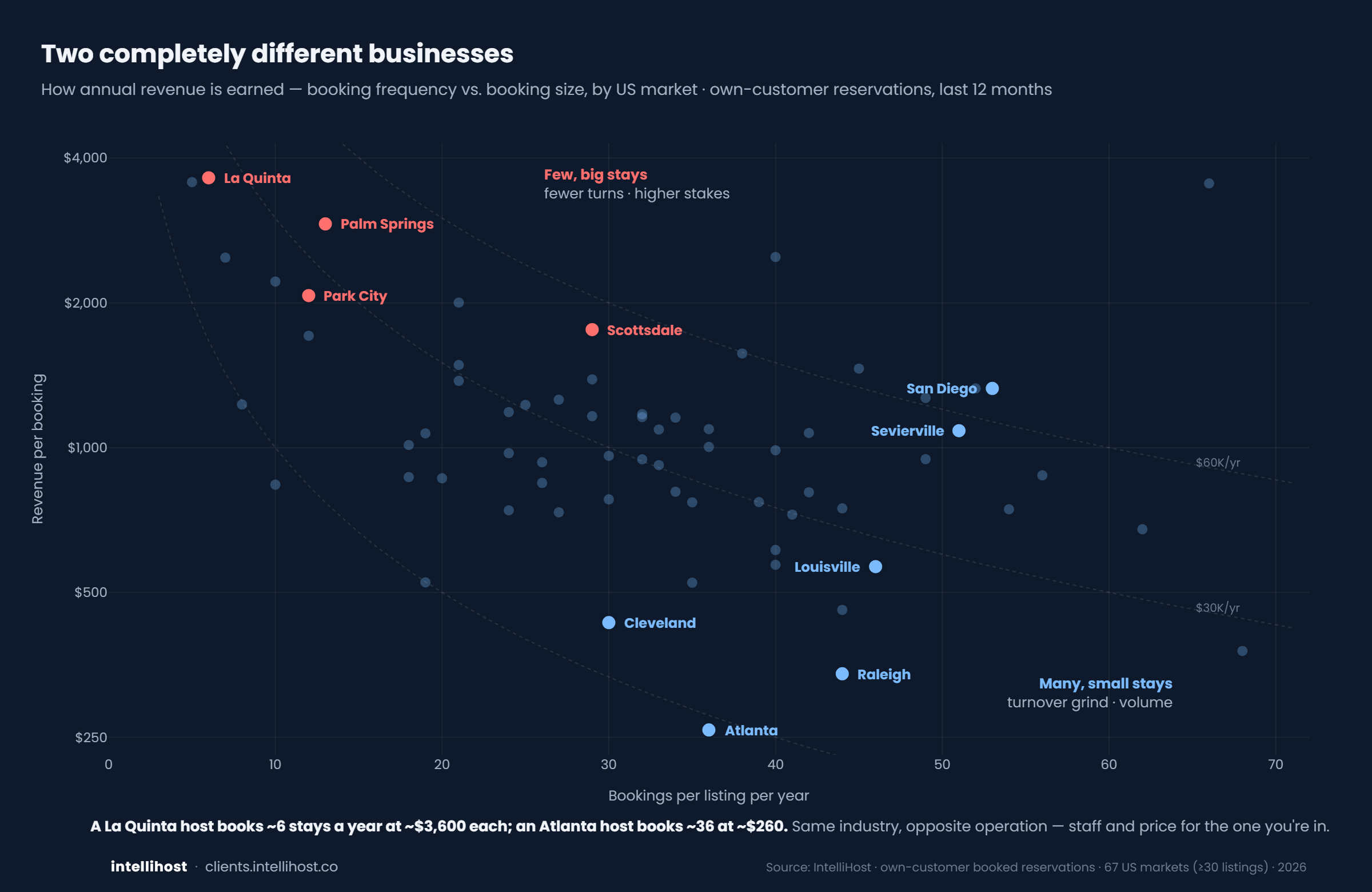
6 bookings vs 36
Based on
67 US markets
Key finding: Two listings can earn nearly the same annual revenue while running as completely different businesses. One books about 6 times a year at roughly $3,600 a stay. The other books about 36 times a year at roughly $260 a stay.
The short version
Annual revenue is one number that hides two very different operations. Booking frequency and value per booking pull in opposite directions across markets. A slow, high-value market rewards patience and margin protection. A fast, low-value market rewards throughput and turnover. If you set your rules for the wrong one, you leave money and sanity on the table.
The data
We split annual revenue into two parts: how often a listing books, and how much each booking is worth. Two market examples show how far apart these can sit.
- A La Quinta listing books about 6 times a year at about $3,600 a stay.
- An Atlanta listing books about 36 times a year at about $260 a stay.
Same industry. Opposite operation. The gap runs through everything, from cleaning cadence to staffing to cancellation exposure.
Why it works
Revenue is frequency multiplied by value, so two markets can land in the same neighborhood by very different paths. In a 6-booking market, each stay is a large share of the year. Losing one to a cancellation or a bad price hurts, so longer minimum nights and firmer pricing make sense. In a 36-booking market, no single stay dominates. The engine runs on turnover, quick cleaning turns, and staying competitive on price across many short windows. The operating model, not just the calendar, changes with the market.
What to actually do
- Split your own annual revenue into bookings per year and average value per booking, per property, before you touch any settings.
- Set your minimum-night rule to match the pattern. Lean longer where stays are few and high value, and stay flexible where volume drives the number.
- Match staffing and cleaning capacity to the real cadence, so a high-frequency market is not starved of turns and a low-frequency one is not overbuilt.
The honest caveats
This is a correlational pattern across markets, not a causal rule. It shows that frequency and value trade off differently by market, and that similar revenue can come from opposite operations. It does not prove that changing your minimum-night rule will move revenue in a specific direction, and it does not set a target booking count for any single property. The two figures cited are market examples, not guarantees for your listing.
Methodology
The finding draws on IntelliHost and Key Data across 67 US markets in 2026. For each listing we separated annual revenue into booking frequency and value per booking, then compared how those two components sit across markets. Comparisons are most meaningful within the same ZIP and bedroom count, where listings face similar demand and similar guests. The La Quinta and Atlanta figures are representative examples of the two ends of that range.
Frequently asked questions
How many times a year should a short-term rental book?
There is no single right number. In our data one market example books about 6 times a year and another about 36, and both can reach similar annual revenue. The right frequency depends on your market’s typical stay value.
Should I use longer minimum-night rules?
It depends on which business your market is. Longer minimums fit low-frequency, high-value markets where each stay is worth about $3,600. High-frequency markets around $260 a stay usually run on flexibility and turnover instead.
Why do two listings with the same revenue operate so differently?
Because revenue is frequency times value, and those two parts can trade off. A listing booking 6 times at $3,600 and one booking 36 times at $260 land near the same revenue while running opposite operations, from cleaning cadence to cancellation exposure.