
Pricing
Your advance bookings are your least reliable
Stop panic-discounting the last-minute ones.
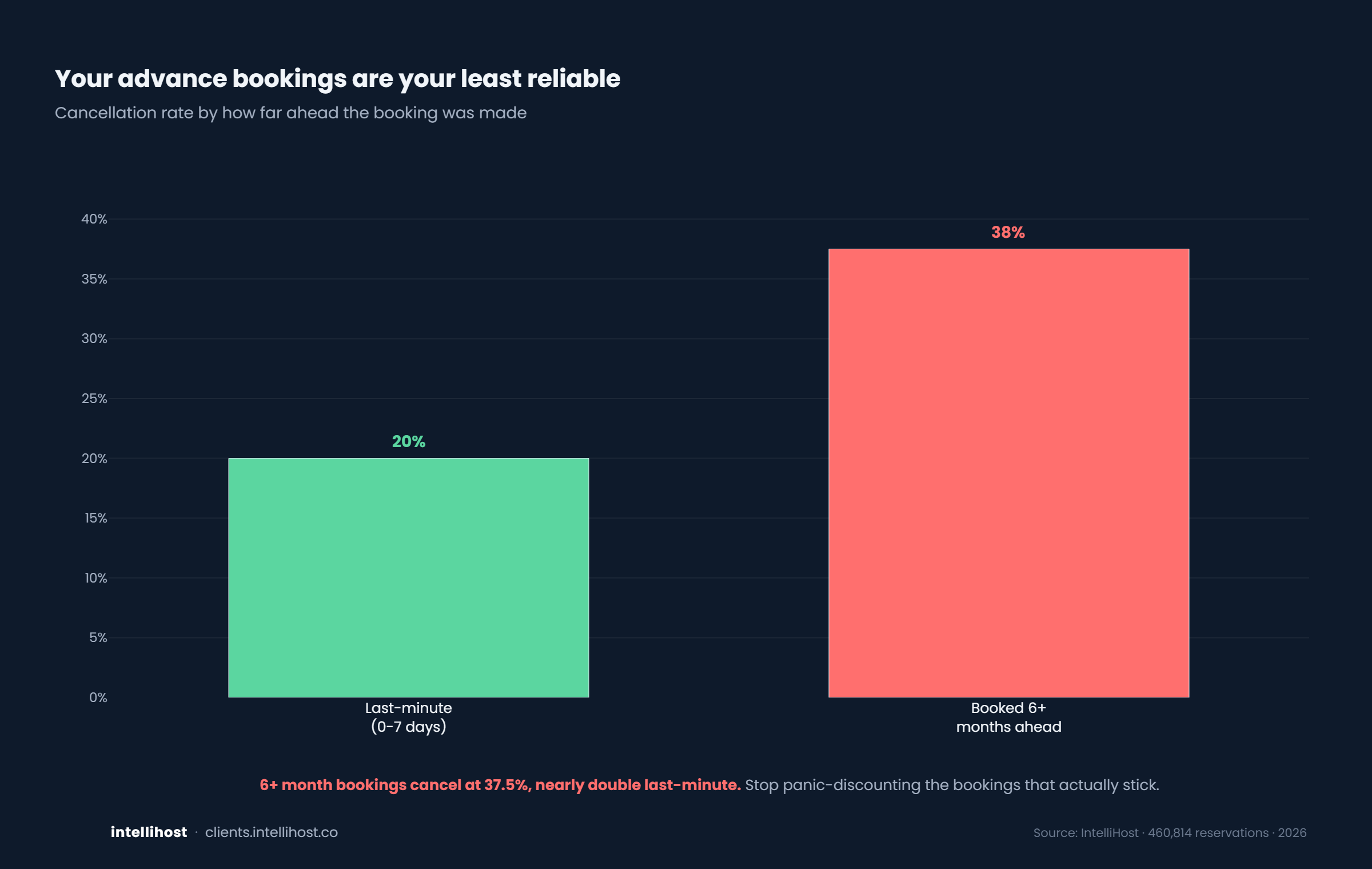
38% vs 20%
Based on
460,814 reservations
Key finding: Bookings made 6 or more months in advance cancel at 37.5%, nearly double the 20% cancellation rate for last-minute bookings, across 460,814 reservations.
The short version
The far-out booking on your calendar is the one most likely to disappear. A stay booked half a year ahead cancels almost twice as often as one booked close to arrival. That means your last-minute bookings are your most reliable revenue, not your weakest. If you have been treating close-in gaps as a failure and slashing prices to fill them, you may be discounting your steadiest income for no reason.
The data
Across 460,814 reservations, the pattern is clear:
- Bookings made 6 or more months ahead cancel at 37.5%.
- Last-minute bookings cancel at 20%.
- That is a gap of 38% versus 20%, or close to double the cancellation rate for advance bookings.
Why it works
Time is the enemy of a booking. The more months between the click and the check-in, the more life happens: plans change, budgets shift, a better option appears, or the trip that felt certain in January feels optional by June. A guest booking for next weekend has already committed their calendar and their money to that trip. A guest booking for next spring is making a soft plan they can walk away from with little cost. Longer lead time simply gives cancellation more room to occur.
What to actually do
- Stop panic-discounting last-minute gaps. Those close-in bookings are your most reliable revenue, so let price hold when demand is near.
- Treat far-out bookings as tentative. Build in a buffer and expect a meaningful share of them to fall away before arrival.
- Consider firmer cancellation terms or deposits on advance stays, where your platform and market allow, to protect against the higher fallout.
The honest caveats
This is a correlation, not a controlled experiment. It shows that advance bookings cancel more often across a very large sample, but it does not prove that lead time alone causes cancellations, and it does not tell you what any single property will see. Trip type, guest, season, and market all vary. Use the pattern to set expectations and strategy, not to predict the fate of one specific reservation.
Methodology
The finding comes from 460,814 reservations analyzed by IntelliHost with Key Data in 2026. Cancellation rates were measured by grouping reservations by how far ahead of check-in they were booked, then comparing the share that cancelled in the far-out group (6 or more months) against the last-minute group. The headline is the difference between those two rates.
Frequently asked questions
Do advance bookings really cancel more than last-minute ones?
Yes. Bookings made 6 or more months ahead cancelled at 37.5% in this data, nearly double the 20% rate for last-minute bookings across 460,814 reservations.
Should I discount to fill last-minute gaps?
Not automatically. Last-minute bookings are your most reliable revenue, cancelling at only 20%, so a near-in gap is not the failure it feels like and often does not need a price cut.
Does this mean I should stop taking advance bookings?
No. Advance bookings still fill your calendar and secure revenue, but because they cancel at 37.5%, it is smart to treat them as tentative and keep a buffer rather than counting them as locked in.