
Reviews
What a bad review actually costs you
In cold, hard dollars.
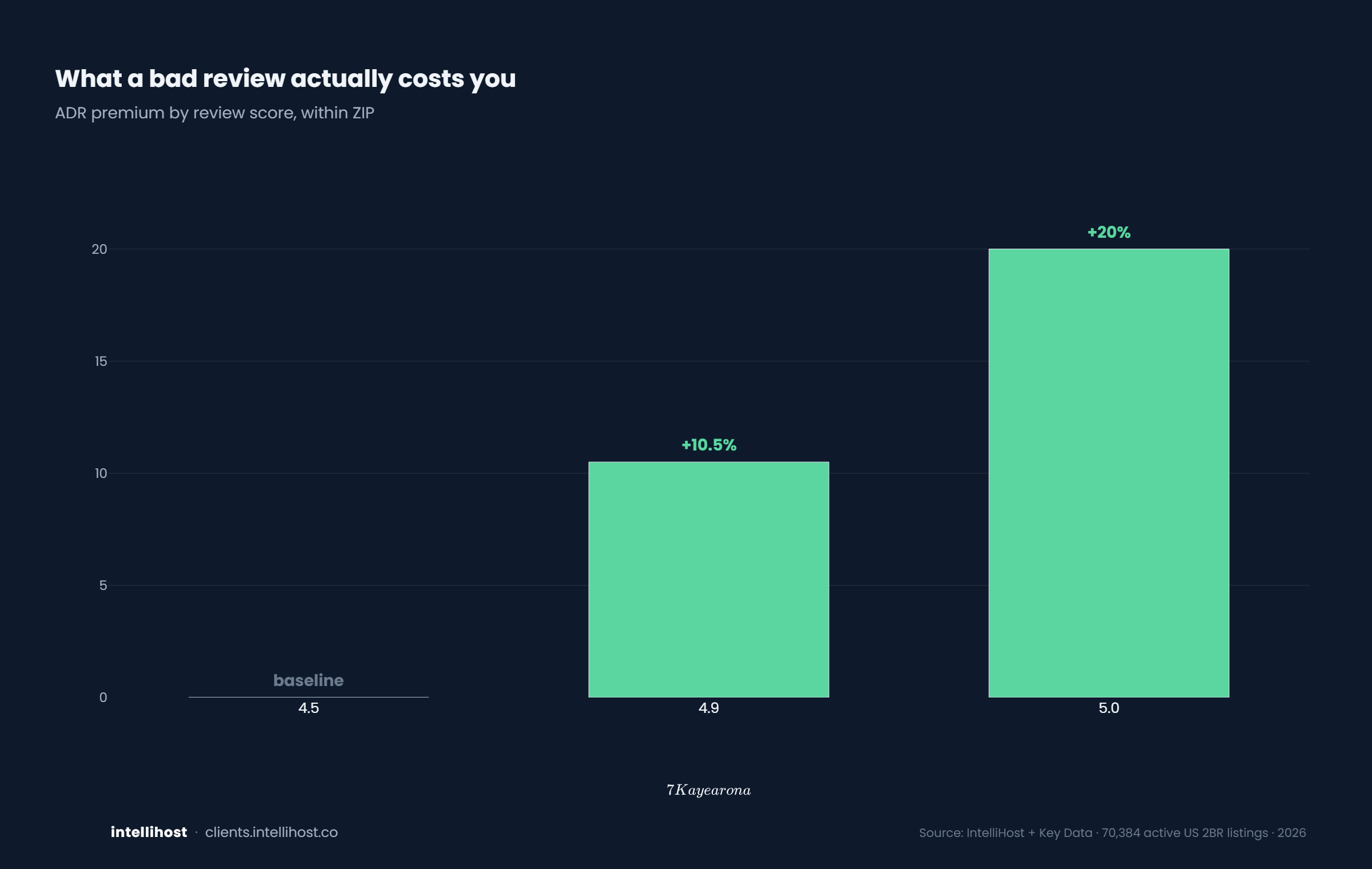
~$7K/yr for 5.0 to 4.9
Based on
70,384 US 2BR listings
Key finding: Slipping from a 5.0 to a 4.9 review score costs about $7,000 a year on a $300 listing, driven entirely by nightly rate.
The short version
Review score buys pricing power. Across the same ZIP, each 0.1 of score is worth roughly 2 to 4 percent in nightly rate. The jump from 5.0 to 4.9 is the expensive one, and a single bad review can push you across it. For an operator, that means guarding a perfect score is not vanity. It is revenue.
The data
We looked at 70,384 US two-bedroom listings and measured how review score relates to nightly rate within the same ZIP.
- Each 0.1 of review score is worth roughly 2 to 4 percent in nightly rate.
- Going from 5.0 to 4.9 costs about $7,000 a year on a $300 listing.
- Half the total pricing power sits in that final 0.1, between 4.9 and 5.0.
- Occupancy stays flat across score tiers, so the gap is a pure rate premium, not a booking-volume effect.
Why it works
A 5.0 is a scarce signal. Most guests trust it more than any photo or description, so a perfect score lets you ask for more and still convert at the same rate. Because occupancy holds flat across tiers, guests are not booking the higher-scored listing more often. They are simply willing to pay more for it. The last 0.1 carries outsized weight because 5.0 reads as flawless while 4.9 reads as merely very good. That small perceived gap is where most of the price premium lives.
What to actually do
- Treat your 5.0 as an asset worth protecting, not a bragging point. Every review that risks it has a real dollar cost.
- Fix the small, predictable complaints before they become reviews. Cleaning misses, broken listings details, and slow responses are the usual culprits.
- If you have already slipped below 5.0, focus on volume of strong recent reviews to rebuild the average, and price with the knowledge that you have given up part of your premium.
The honest caveats
This is a correlation, not a controlled experiment. We are not claiming that raising your score by 0.1 will automatically add the premium to your specific listing. Higher-scored listings may differ in ways we did not measure. The scope is US two-bedroom listings compared within the same ZIP, so results for other markets, sizes, or property types may differ. What the data shows is a consistent, sizable rate gap tied to score, most of it concentrated in the final 0.1.
Methodology
The sample is 70,384 US two-bedroom listings, using IntelliHost and Key Data figures from 2026. We compared nightly rate against review score within the same ZIP to control for local market differences, and held bedroom count constant at two. Occupancy was measured across the same score tiers to separate rate effects from booking-volume effects.
Frequently asked questions
How much does one bad review cost a short-term rental?
Enough to move you from 5.0 to 4.9, which runs about $7,000 a year on a $300 listing. A single low rating can be the one that pushes your average across that line.
Why is going from 5.0 to 4.9 such a big deal?
Because half of the total pricing power in the data sits in that last 0.1. A 5.0 reads as flawless to guests, and they pay a premium for it that a 4.9 does not command.
Does a lower review score mean fewer bookings?
No. Occupancy stayed flat across score tiers in this sample. The cost of a lower score shows up entirely in the nightly rate you can charge, not in how often you book.