
Market
The most and least price-sensitive cities
Where you can push rate, and where you can't.
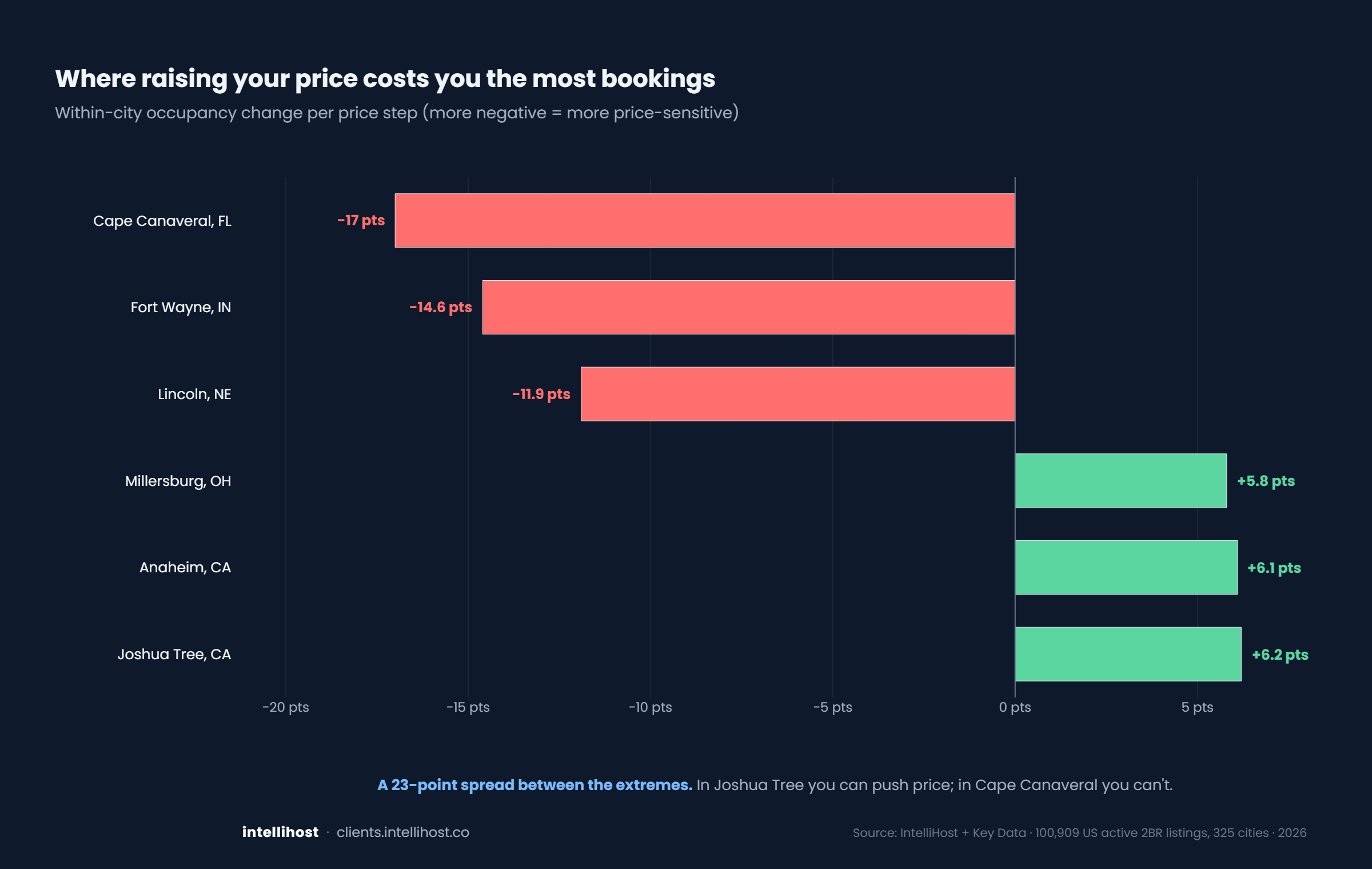
23-point spread
Based on
100,909 US listings, 325 cities
Key finding: Across 325 US cities, the gap between the most and least price-sensitive market is 23 points, meaning a rate increase costs you far more occupancy in Cape Canaveral than the same increase would in Joshua Tree.
The short version
Price sensitivity is not the same everywhere. In some cities, occupancy falls off fast the moment you raise your nightly rate. In others, you can push price and lose almost nothing. That difference is worth 23 points across the US market, and it means your pricing aggressiveness should be set by your city, not by a national rule of thumb.
The data
We ranked 325 US cities by how much occupancy moves when price moves. The two ends of that ranking tell the story.
- Most price-sensitive: Cape Canaveral. Raising rate here costs you bookings quickly.
- Least price-sensitive: Joshua Tree. You can push price with little occupancy lost.
- The spread between the most and least sensitive city is 23 points.
Why it works
Demand in a market has a shape. Where guests have many similar options and flexible travel dates, they shop hard on price, so a higher rate pushes them to a cheaper listing or a different weekend. Where the destination itself is the draw and supply is thinner, guests are less willing to trade down, so rate matters less to whether they book. Cape Canaveral and Joshua Tree sit at opposite ends of that spectrum. The same dollar increase behaves like two different moves depending on which market you are in.
What to actually do
- Find out where your city falls on the sensitivity ranking before you set a pricing strategy, rather than copying tactics from a host in a different market.
- In a low-sensitivity market, test higher rates on your strong dates and watch occupancy. You may be leaving money on the table by pricing like you are in a competitive market.
- In a high-sensitivity market, be careful with big rate jumps. Small, gradual moves and sharp competitive pricing protect your occupancy.
The honest caveats
This is a correlational finding. It shows how occupancy and price move together across cities, not a controlled test of what happens when a single host raises rates. The 23-point spread describes the two extreme cities in the ranking, so most markets sit somewhere in between. Your own listing can behave differently from its city depending on your quality, reviews, and comp set. Treat the city ranking as the starting point, not the final answer for your specific property.
Methodology
The analysis covers 100,909 US listings across 325 cities, drawn from IntelliHost and Key Data in 2026. For each city we measured how occupancy moves when price moves, then ranked all 325 cities on that sensitivity. Cape Canaveral came out as the most sensitive market and Joshua Tree as the least, with a 23-point spread between them. Comparisons are drawn within markets so the ranking reflects local demand behavior rather than differences between one city and another.
Frequently asked questions
Which US city is the most price-sensitive for short-term rentals?
Cape Canaveral is the most price-sensitive city in this ranking of 325 US markets. Raising your rate there costs you bookings faster than in almost any other market.
Where can I raise rates without losing much occupancy?
Joshua Tree is the least price-sensitive city in the study, which means you can push price with little occupancy lost. Low-sensitivity markets in general give you more room to raise rates on strong dates.
Should I use the same pricing strategy everywhere?
No. The gap between the most and least sensitive city is 23 points, which is large enough that a single national rule of thumb will overprice some markets and underprice others. Set your pricing aggressiveness by your city.