
Property
Listing age is a U-curve, not a slope
Year 2-3 is the sweet spot.
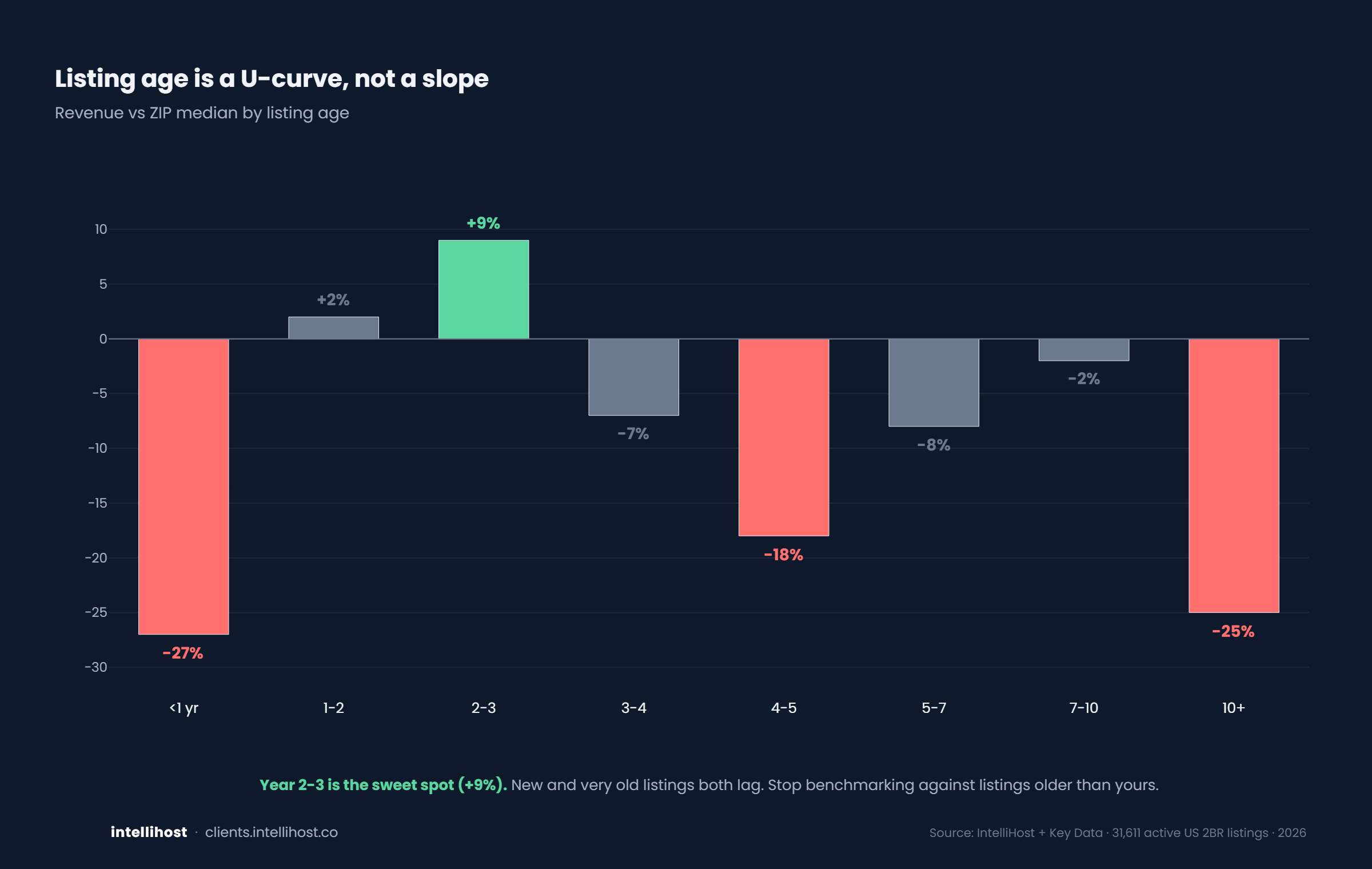
+9% at 2-3 years
Based on
31,611 US 2BR listings
Key finding: Within a ZIP code, 2BR listings in their 2-to-3 year window earn about 9 percent above the local median, while brand-new listings sit 27 percent below it and very old listings fade to 25 percent below.
The short version
Listing age does not move revenue in a straight line. It follows a U-curve. New listings ramp up from a cold start, hit their peak around years two and three, then slowly drift back down. If you are new, you are not broken. If you are old, you are not automatically ahead. Knowing where you sit on the curve changes who you should be comparing yourself to.
The data
We looked at revenue by listing age for 2-bedroom listings, measured within ZIP code so you are comparing like with like. Three points define the curve:
- New listings sit 27 percent below the local median during cold start.
- The 2-to-3 year window peaks at 9 percent above median.
- Very old listings fade back to 25 percent below median.
That peak-to-trough spread is the whole story. Age helps, then it stops helping.
Why it works
A new listing has no review history, no booking signal, and no track record for the platform to trust, so it starts cold and has to earn its way up. By years two and three, it has enough reviews, enough completed stays, and enough ranking momentum to command a premium in its market. After that, other forces catch up. Older units often carry dated photos, aging furnishings, and pricing habits that stopped keeping pace with newer, sharper competitors nearby. The listing did not get worse overnight. The market around it got better.
What to actually do
- Find your age on the curve first. A listing under a year old is expected to underperform, so judge it against that, not against a five-year-old neighbor.
- If you are approaching or inside the 2-to-3 year window, push hard. This is when your listing is most able to hold a premium, so this is the time to be aggressive on pricing and visibility.
- If you run an older unit, treat the fade as a prompt to refresh. Update photos, review your pricing against current comps, and stop assuming seniority alone is doing the work.
The honest caveats
This is a correlation, not a controlled experiment. It shows that listing age and revenue move together in a U-shape, not that age directly causes revenue. Newer and older listings differ in many ways beyond age, including photo quality, pricing discipline, and management style, and this study does not isolate those. The finding covers 2-bedroom US listings compared within ZIP code. It does not prove that any single listing will follow the average curve, and it does not tell you what a given unit will earn.
Methodology
The analysis drew on 31,611 US 2-bedroom listings, using IntelliHost and Key Data figures from 2026. Revenue was measured by listing age and benchmarked within ZIP code so that local market conditions are held roughly constant. Holding bedroom count and ZIP fixed is what lets age stand out as the variable of interest rather than getting drowned out by location and property size.
Frequently asked questions
When does a short-term rental listing earn the most?
In this data, the 2-to-3 year window is the peak, at about 9 percent above the local median for 2-bedroom listings. Before that, listings ramp up from a cold start. After that, they slowly fade.
Why is my brand-new listing underperforming?
New listings in this study sit 27 percent below the local median during cold start. That is expected, not a sign something is broken. Your listing is still building the reviews and booking history it needs to climb.
Should I compare my listing to much older ones nearby?
No. Very old listings fade to 25 percent below median, so they face a different problem than you do. Compare yourself to listings close to your own age and in your ZIP and bedroom count.