
Pricing
Occupancy is a vanity metric
Charge more, fill less, earn more.
+22% RevPAR
Based on
107,379 US 2BR listings
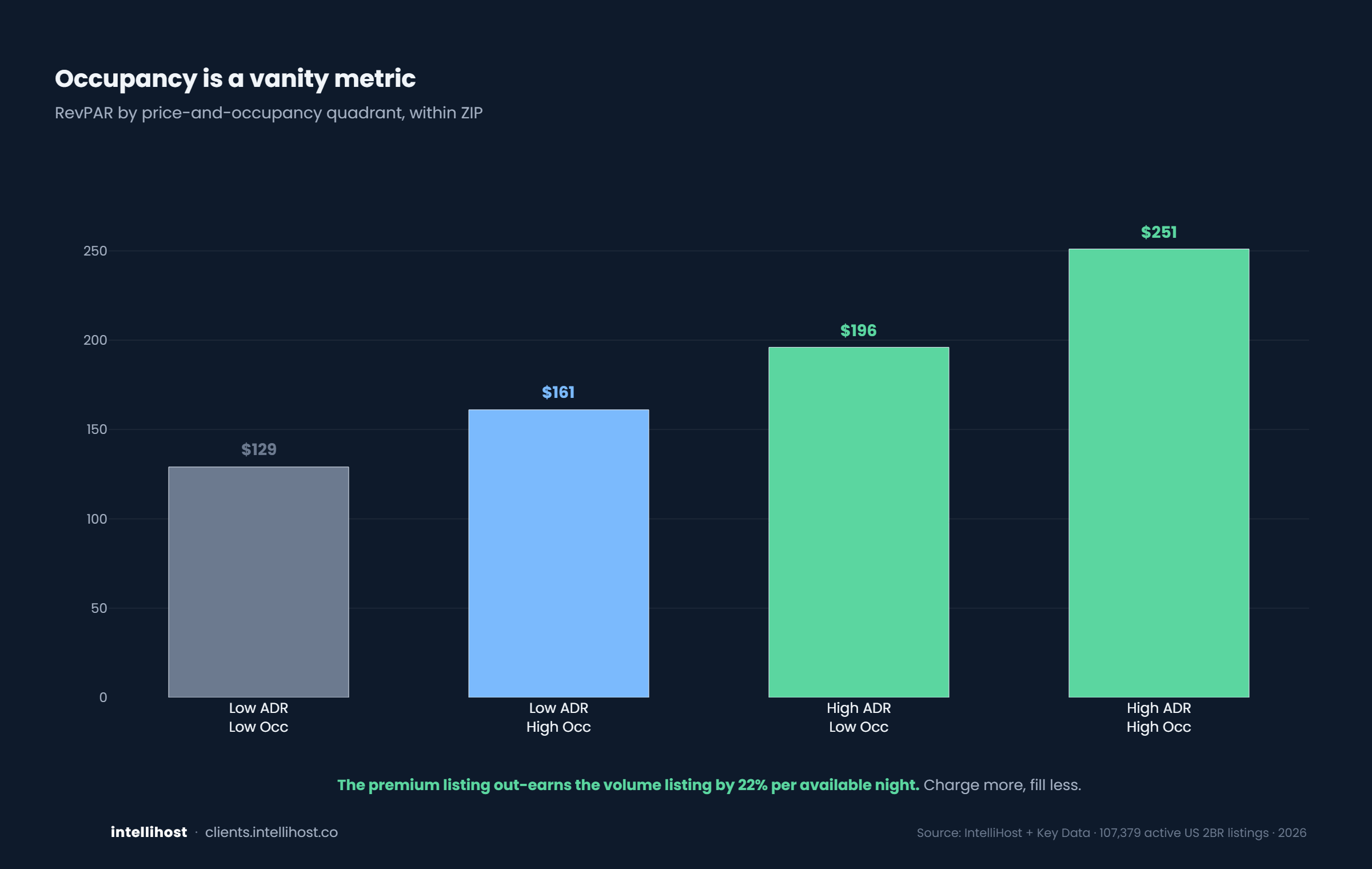
Key finding: Across 107,379 US 2-bedroom listings, premium listings (higher rate, lower occupancy) earned about 22% more RevPAR than volume listings (lower rate, higher occupancy).
The short version
Occupancy is the number that feels the best and means the least. When we split listings by price and occupancy, the ones that charged more and filled less still out-earned the ones that filled up cheap. For an operator, this flips the usual instinct. A full calendar is not the win. Revenue per available night is the win, and protecting your rate is how you get there.
The data
We looked at 107,379 US 2-bedroom listings and grouped them by rate and occupancy.
- Premium listings (high rate, lower occupancy) earned about 22% more RevPAR per available night than volume listings (low rate, high occupancy).
- A listing charging $316 at 64% occupancy out-earned a listing at $201 and 81% occupancy.
Those are the only figures in this study. The higher-priced, less-full listing simply took home more money.
Why it works
RevPAR is rate multiplied by occupancy, so a higher rate does a lot of heavy lifting. A listing does not need to fill every night to win. It needs the nights it does book to be worth more. Chasing occupancy usually means cutting rate, and each cut lowers the value of every booked night, not just the marginal one. The volume listing works harder for less. It hosts more guests, absorbs more cleaning turns and more wear, and lands below the listing that held its price.
What to actually do
- Stop treating occupancy as the scoreboard. Track RevPAR instead, so a full-but-cheap calendar cannot masquerade as a win.
- Test raising your rate before you assume the calendar needs to be full. A few empty nights at a strong price can beat a full month at a soft one.
- Hold your floor. When bookings slow, resist the reflex to discount your way to occupancy. Protect the rate first.
The honest caveats
This is a correlational finding, not a controlled test. It shows that higher-rate, lower-occupancy listings tended to earn more RevPAR in this sample. It does not prove that raising your own price will always raise your revenue, and it does not mean any single listing should chase the same numbers. The scope is US 2-bedroom listings. Markets, seasons, and property quality all shape what rate a listing can actually hold. Use it as a reason to test your price, not as a guarantee.
Methodology
The study draws on 107,379 US 2-bedroom listings, using IntelliHost data alongside Key Data, measured in 2026. We split listings into premium (higher rate, lower occupancy) and volume (lower rate, higher occupancy) groups and compared RevPAR, revenue per available night, between them. Focusing on a single bedroom count keeps the comparison closer to like-for-like on property size.
Frequently asked questions
Is higher occupancy always better for short-term rental revenue?
No. In this study of 107,379 listings, the higher-occupancy volume group earned about 22% less RevPAR than the higher-rate premium group. Filling the calendar is not the same as earning the most.
What is RevPAR and why does it matter more than occupancy?
RevPAR is revenue per available night, your rate multiplied by your occupancy. It matters more because it captures both how much you charge and how often you book. A listing can win on RevPAR while running a less-than-full calendar, which is exactly what the premium group did.
Should I raise my nightly rate even if it lowers my occupancy?
It is worth testing. In this sample, a listing at $316 and 64% occupancy out-earned one at $201 and 81% occupancy. Higher rate with fewer nights beat lower rate with more, though results will vary by market, so test rather than assume.