
Amenities
Self check-in is table stakes now
The listings without it are quietly bleeding.
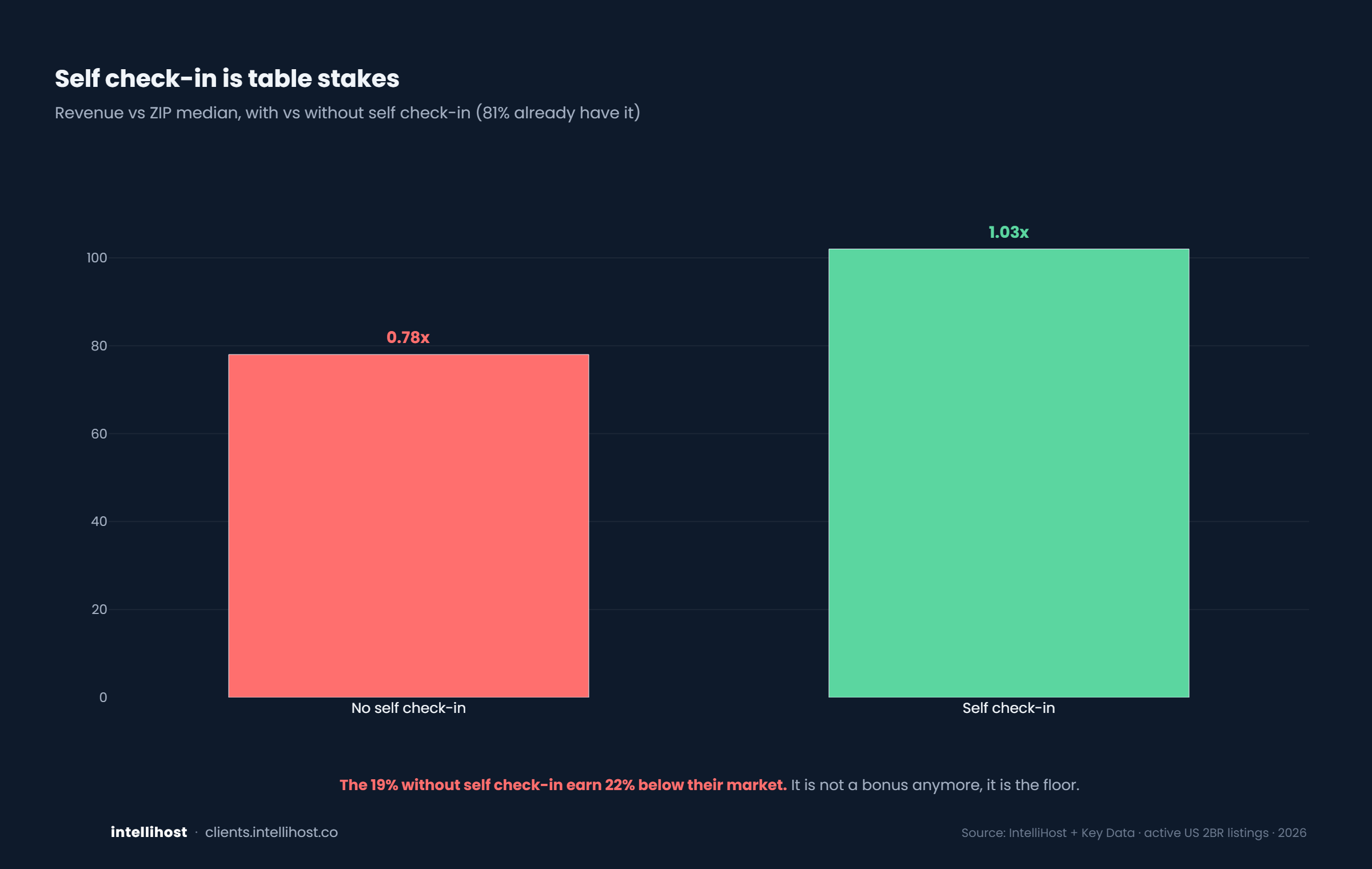
-22% without it
Based on
Active US 2BR listings
Key finding: Active US 2-bedroom listings without self check-in earn about 22% below their market, while 81% of listings already offer it.
The short version
Self check-in stopped being a nice-to-have. It is now the baseline that most guests expect. If your listing still relies on in-person key handoffs, it sits in the small minority that earns roughly 22% less than the market around it. That gap is large enough to change your whole year.
The data
Across active US 2-bedroom listings in 2026:
- 81% already offer self check-in.
- The 19% that do not earn about 22% below their market.
Those are the only two numbers here, and they tell a clear story. Self check-in went from a differentiator to the floor. The listings without it are the exception, and they pay for it.
Why it works
Guests book short-term rentals partly to avoid the friction of a hotel front desk and the coordination of meeting someone with a key. Self check-in removes the one point of arrival that depends on two schedules lining up. It also widens who will book you, because late flights and odd arrival times stop being a problem. When most listings in a market offer it, the ones that do not start to look higher-effort and higher-risk to a guest scanning results. Over a full calendar, that friction compounds into fewer bookings and lower rates.
What to actually do
- Install a lockbox or a smart lock so guests can arrive on their own schedule.
- Write clear arrival instructions and photos into your listing and your pre-arrival message.
- Remove every in-person handoff from your process so no booking depends on you being there.
The honest caveats
This is a correlational finding, not a controlled test. It shows that listings without self check-in earn about 22% below their market, but it does not prove that adding a lock alone recovers that full gap. Listings that still do in-person handoffs may differ in other ways too. The scope is active US 2-bedroom listings in 2026, so treat it as strong directional evidence rather than a guarantee for every property type or region.
Methodology
The finding draws on active US 2-bedroom listings in 2026, using combined IntelliHost and Key Data sources. Listings were grouped by whether they offer self check-in, and earnings were compared against each listing’s own market. Holding bedroom count fixed at two and comparing within market keeps the comparison closer to like-for-like, which is why the 22% gap is meaningful rather than a reflection of different property sizes.
Frequently asked questions
How much less do listings without self check-in earn?
About 22% below their market, based on active US 2-bedroom listings in 2026. That is the core gap this study measured.
Is self check-in still worth adding if most hosts already have it?
Yes. 81% of listings already offer it, which means the 19% without it are the ones standing out for the wrong reason and earning roughly 22% less.
Does a lockbox count as self check-in?
Yes. A lockbox or a smart lock both let guests arrive on their own schedule without meeting you, which is the whole point of the feature.