
Reviews
Slow replies cost real money
And the fix is free.
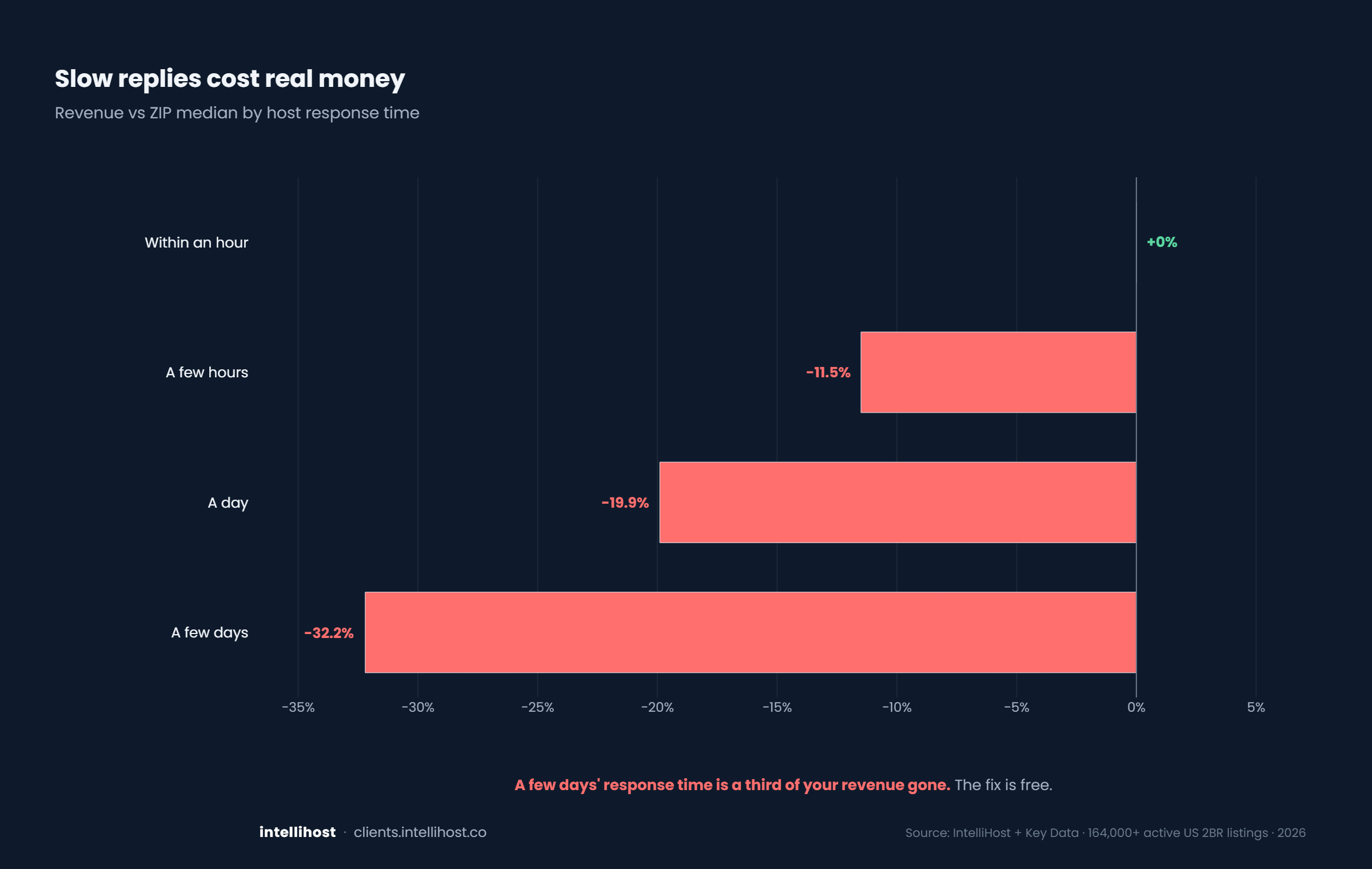
-32% at a few days
Based on
164,000+ US 2BR listings
Key finding: Across 164,000+ US two-bedroom listings, listings that took a few days to reply earned about 32% less revenue than listings that replied within an hour.
The short version
How fast you answer a guest tracks closely with how much you earn. Reply within an hour and you sit at the baseline. Let messages age and revenue falls in a steep, clean line. This is one of the rare fixes that costs nothing but attention, so it is worth getting right this week.
The data
We looked at 164,000+ US two-bedroom listings and lined up response time against revenue. The pattern is a steady downward slope:
- Reply within an hour: baseline revenue.
- A few hours to reply: about 12% lower.
- A day to reply: about 20% lower.
- A few days to reply: about a third lower, roughly 32%.
The gradient is sharp. Every step slower costs more.
Why it works
Guests booking a trip are often deciding between a handful of listings at once. The host who answers first stays in the running, and the slow one drops out of the conversation. Booking platforms also read fast responses as a sign of an attentive, reliable operator, which can help how often your listing gets shown. So part of this is a ranking and visibility effect and part of it is simply winning the guest who was ready to book. Response time is also a proxy for overall operator quality, and quality tends to show up everywhere in the numbers. Whatever the mix, the slope is steep enough to act on.
What to actually do
- Automate your guest messaging so first replies go out in under an hour, day or night.
- Set up saved replies for the questions you answer most, like check-in details, parking, and availability.
- Turn on push alerts for new inquiries so nothing sits unread while you are away from your desk.
The honest caveats
This is a correlation, not proof of cause. Faster replies line up with higher revenue, but we cannot say from this data alone that speeding up your replies will move your revenue by an exact amount. Response time also reflects general operator quality, so some of the gap belongs to hosts who simply run a tighter operation across the board. The finding covers US two-bedroom listings, so treat it as directional if your listings look very different. It tells you the direction to move, not a guaranteed dollar figure.
Methodology
The study draws on 164,000+ US two-bedroom listings, using IntelliHost data alongside Key Data for 2026. We grouped listings by how quickly they typically responded to guests and compared revenue across those groups. Holding to a single bedroom count keeps the comparison closer to like for like, so response-time differences are not being confused with size differences.
Frequently asked questions
How much does a slow response time cost on a vacation rental?
In this study, listings that took a few days to reply earned about 32% less than those replying within an hour, across 164,000+ US two-bedroom listings. A few hours cost about 12% and a full day about 20%.
What is a good response time for short-term rental hosts?
Under an hour is the baseline in this data, and it is the group that earned the most. Getting first replies to sub-hour, including overnight, is the target worth aiming for.
Does replying faster guarantee more revenue?
No. The relationship is correlational, so faster replies line up with higher revenue but are not proven to cause a specific increase. It is still a free, low-risk change with a clear direction behind it.