
Property
Where the big house actually pays off
Size doesn't always matter.
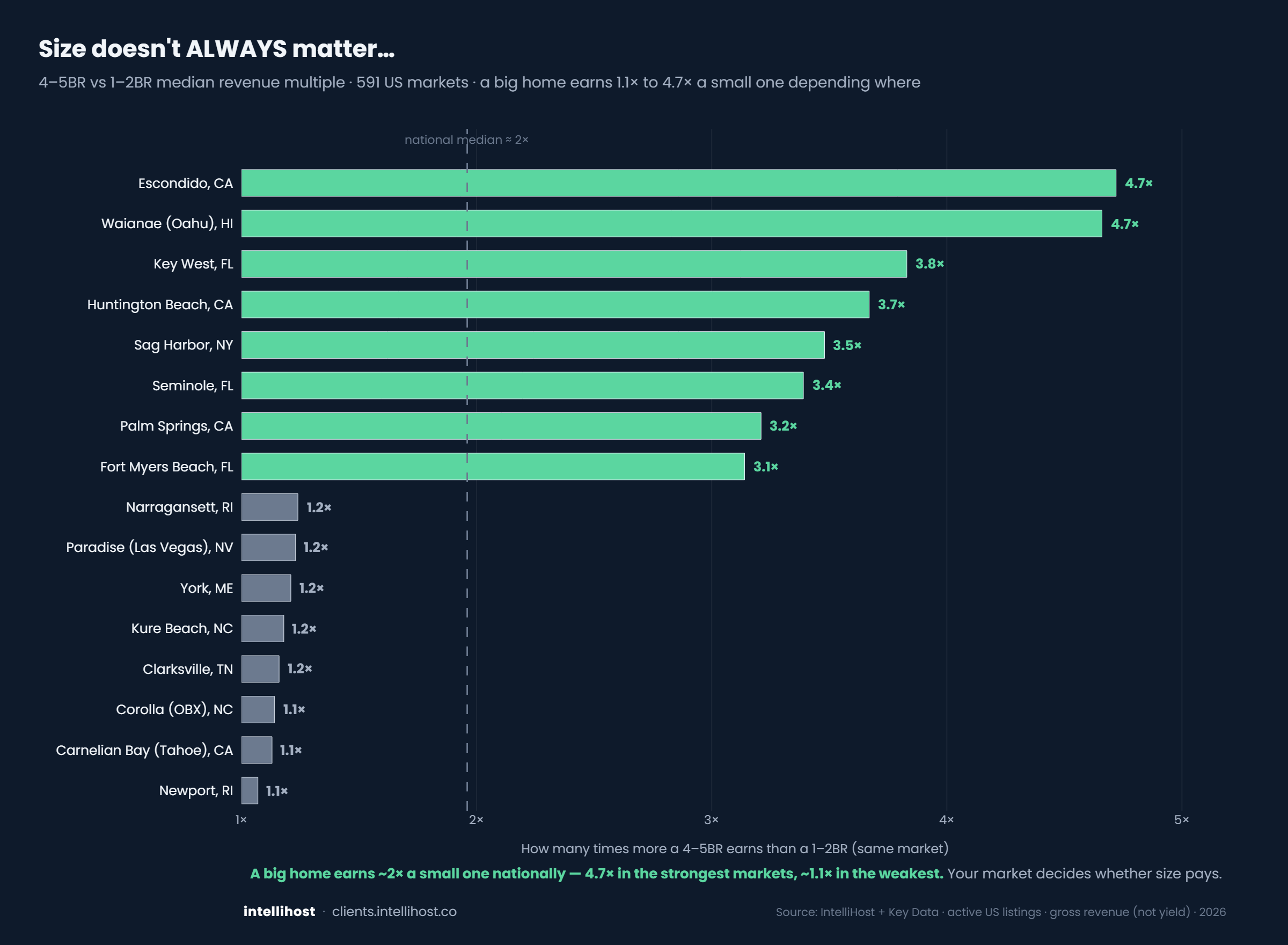
1.1x to 4.7x by market
Based on
591 US markets
Key finding: A 4-5 bedroom home earns about 2x a 1-2 bedroom nationally, but that multiple runs anywhere from 1.1x to 4.7x depending on the market, across 591 US markets.
The short version
The big house is not a universal win. In some markets an extra bedroom is a payday. In others it is mostly extra cost. The national average of 2x hides a huge spread, so the only number that should drive your portfolio decisions is the multiple for your own market.
The data
Across 591 US markets, here is what we measured:
- Nationally, a 4-5 bedroom home earns about 2x what a 1-2 bedroom earns.
- That multiple ranges from 1.1x to 4.7x depending on the market.
- In group destinations like Palm Springs and Key West, the big house acts as a different, less-competitive product.
- In markets where small units already earn well, extra bedrooms mostly add cost rather than revenue.
Why it works
Size pays off when the big house is a distinct product rather than a scaled-up version of the small one. In group destinations, families and friend groups need a place that sleeps everyone under one roof. Few listings serve that demand, so the large home competes in a thinner pool and commands a premium. In markets built around couples, solo travelers, or short business stays, the demand for a large home is smaller and the small unit already captures the high-value guest. There, the extra bedrooms add cleaning, furnishing, maintenance, and carrying cost without a matching lift in nightly rate.
What to actually do
- Pull the earnings multiple for 4-5 bedroom versus 1-2 bedroom homes in your specific market before you commit capital.
- If your market sits near the top of the range, weight new acquisitions toward larger group-friendly homes.
- If your market sits near the bottom, favor smaller units and put your money into rate and occupancy on what you already own.
The honest caveats
This is a correlational finding, not a causal one. It shows how earnings track with bedroom count across markets. It does not prove that adding bedrooms to a given property will produce a specific return. The 1.1x to 4.7x range describes market averages, and any single property can land above or below its market’s typical multiple based on condition, location within the market, and management. Use the multiple as a screen, not a guarantee.
Methodology
We analyzed 591 US markets using IntelliHost and Key Data figures for 2026. For each market we compared typical earnings for 4-5 bedroom homes against 1-2 bedroom homes and expressed the result as a multiple. Comparisons were made within market so that local demand and pricing are held constant, then summarized to the national average and the full range across markets.
Frequently asked questions
Do bigger vacation rental homes always earn more?
On average a 4-5 bedroom home earns about 2x a 1-2 bedroom, but the range is 1.1x to 4.7x by market. In some markets the premium is small enough that the extra costs eat it up.
Which markets reward large homes the most?
Group destinations like Palm Springs and Key West sit toward the high end, because a large home there is a distinct, less-competitive product that serves group travel demand.
When is a big home not worth it?
In markets where small units already earn well, extra bedrooms tend to add cost without a matching lift in revenue, pushing the multiple toward the low end near 1.1x. Run your own market’s number before buying.