
Market
A studio and a 5-bedroom aren't the same business
It starts with when guests book.
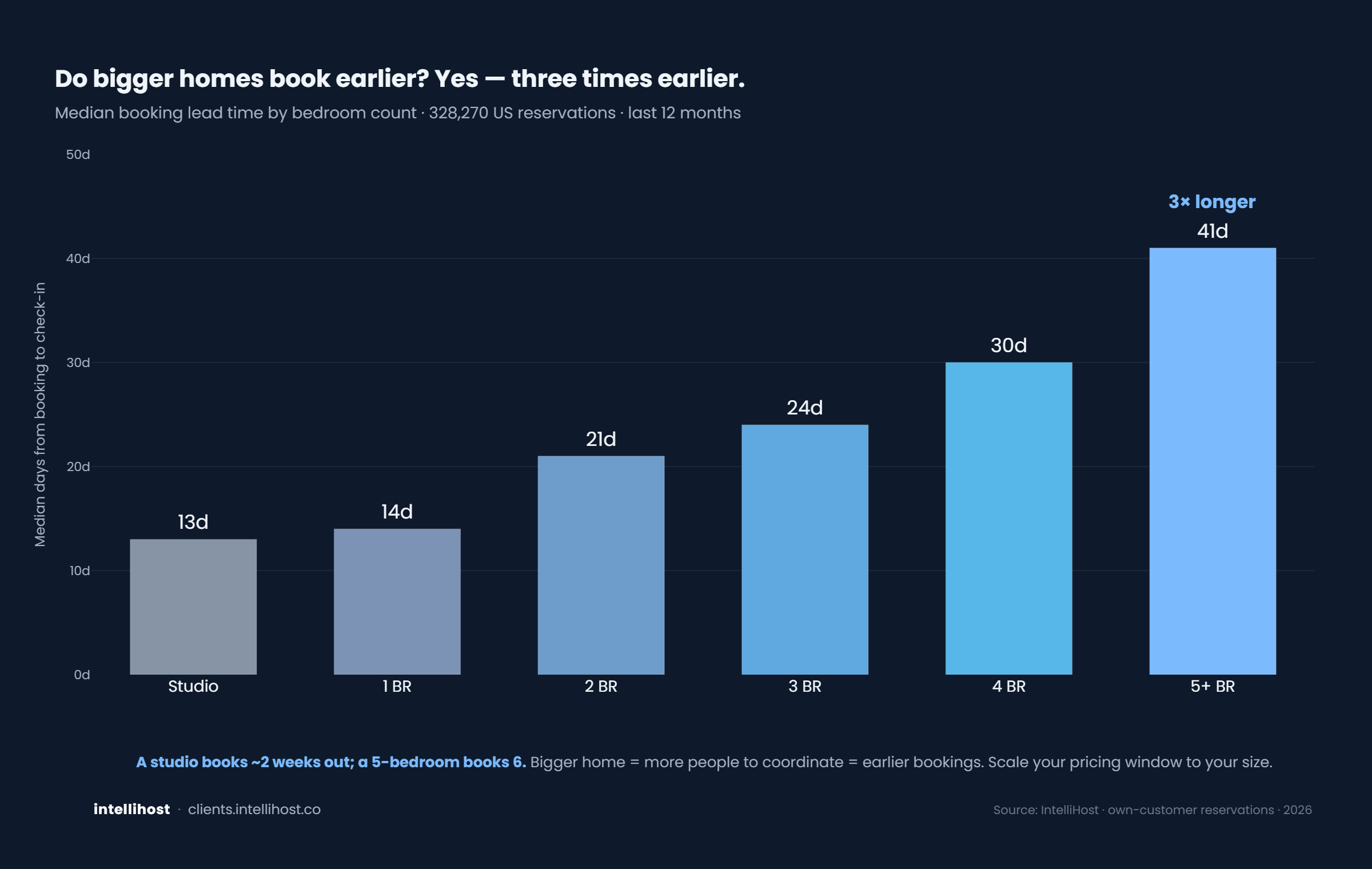
13 vs 41 days
Based on
328,270 US reservations
Key finding: Across 328,270 US reservations, studios book about 13 days out while 5-bedroom homes book about 41 days out. That is a 28-day gap in when your guests decide.
The short version
Booking lead time scales with property size. Small homes attract last-minute travelers. Big homes attract groups who lock in plans well ahead. This matters because your pricing and availability strategy should follow your guests’ planning timeline, not a single one-size-fits-all calendar. A studio and a 5-bedroom are not the same business.
The data
The numbers come straight from the reservation data. Nothing here is estimated.
- Median booking lead time for studios: about 13 days out.
- Median booking lead time for 5-bedrooms: about 41 days out.
- 59% of 5-bedroom bookings come 30 or more days ahead.
- 29% of studio bookings come 30 or more days ahead.
So a 5-bedroom is roughly twice as likely to be booked a month or more in advance as a studio.
Why it works
Bigger homes mean groups. Groups mean coordination. When five or six people need to agree on dates, split costs, and book flights, they plan earlier. A solo traveler or a couple in a studio can decide on a Thursday for a weekend away. A family reunion or a friends’ trip in a 5-bedroom cannot. The size of the home is really a proxy for the size and complexity of the trip behind it, and complexity pushes decisions earlier.
What to actually do
- Match your pricing horizon to your property size. If you run larger homes, price and open your calendar further out, because your best demand shows up 30 or more days ahead.
- For studios and small units, protect your near-term dates. Last-minute demand is your bread and butter, so avoid overselling far-out inventory at low rates.
- Stop applying one lead-time playbook across a mixed portfolio. Segment your strategy by bedroom count and watch when bookings actually land.
The honest caveats
This is a correlation, not proof of cause. Larger properties tend to book earlier, but size itself is not the only thing at work. Group travel, trip type, seasonality, and market can all move lead time. The finding describes a clear pattern across a large US sample. It does not promise that raising your bedroom count will change when your specific guests book, and it does not replace watching your own calendar.
Methodology
The analysis draws on 328,270 US reservations, combining IntelliHost and Key Data records from 2026. Booking lead time is measured as the number of days between when a reservation is made and the check-in date. We report the median rather than the average, so a few extreme early or late bookings do not distort the picture. Properties are grouped by bedroom count, comparing studios against 5-bedroom homes.
Frequently asked questions
How far in advance do vacation rentals get booked?
It depends heavily on size. In this sample, studios book about 13 days out at the median and 5-bedrooms about 41 days out. Bigger homes get booked earlier.
Do larger short-term rentals really book earlier than studios?
Yes. 59% of 5-bedroom bookings come 30 or more days ahead, versus 29% for studios. Larger homes are roughly twice as likely to book a month or more in advance.
Should I price my properties differently based on bedroom count?
The data supports scaling your pricing horizon with size. Larger homes see meaningful demand 30-plus days out, so opening and pricing those dates earlier fits how their guests plan, while small units lean on near-term bookings.