
Pricing
Where long-stay discounts actually matter
It's about your ZIP, not your listing.
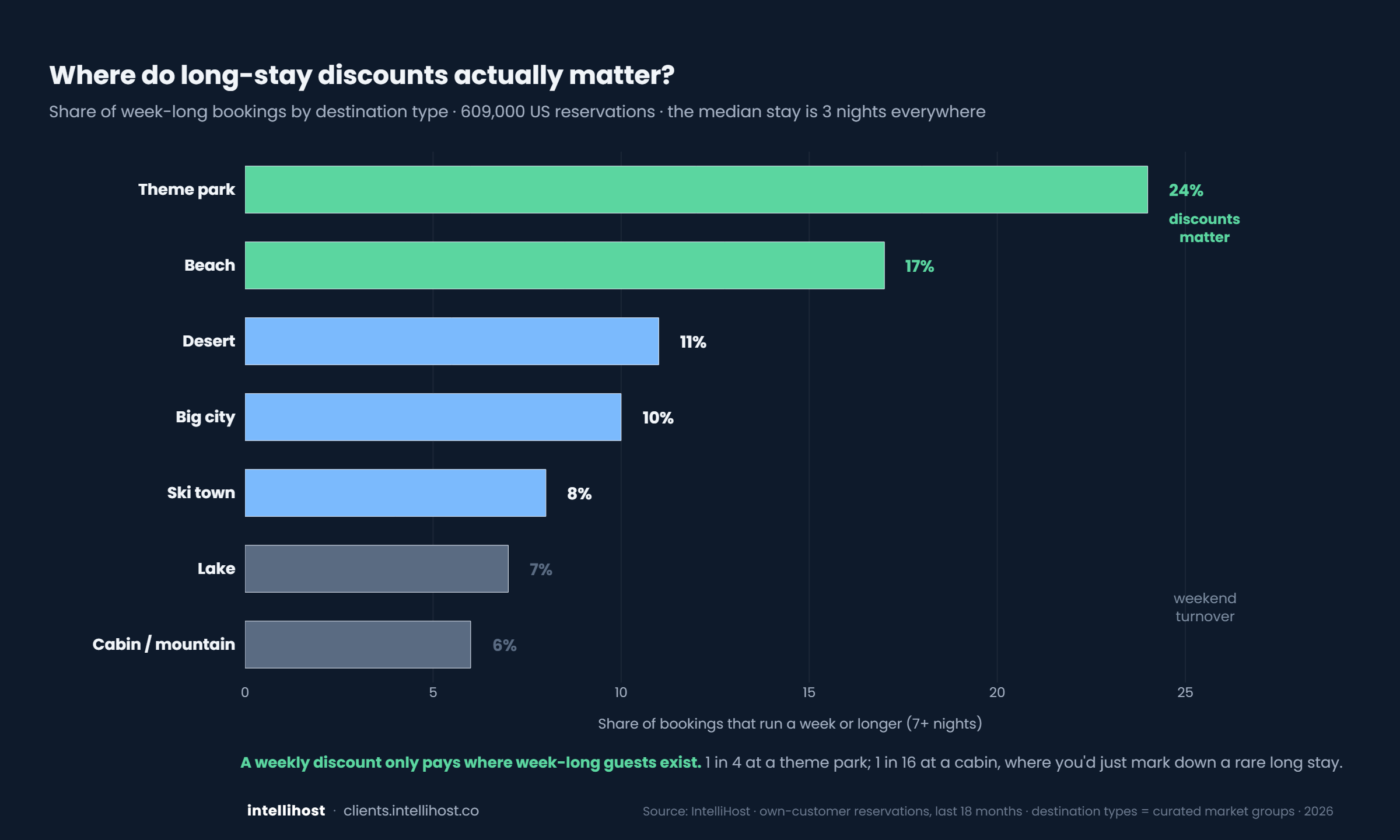
Theme park 24% vs cabin 6%
Based on
609,000 US reservations
Key finding: Week-long bookings make up 24% of stays in theme-park markets but only 6% in cabin markets, a swing of more than 4x, based on 609,000 US reservations.
The short version
A weekly discount only pays off if week-long guests actually show up. In most markets, the median stay is three nights, so a seven-night discount often rewards a booking length that rarely happens. Whether the discount helps or just gives away money depends far more on where your listing sits than on the listing itself. Turn it on where long stays are common. Turn it off where they are not.
The data
Across 609,000 US reservations, the picture is clear:
- The median stay is three nights in nearly every market.
- The share of week-long bookings swings more than 4x by market.
- Theme-park markets: 24% of bookings are week-long.
- Cabin markets: 6% of bookings are week-long.
Beach and theme-park markets carry real week-long demand. Cabin, lake, city, and ski markets do not.
Why it works
A weekly discount is a trade. You give up nightly rate in exchange for more long bookings. That trade only makes sense if long bookings are on the table to win. In a theme-park market, families plan seven-night trips, so a discount can tip them toward booking and toward staying longer. In a cabin market, most guests want a weekend, so the discount lands on short stays that would have booked anyway. Same tool, opposite result, driven by the market you are in.
What to actually do
- Identify your market type. Beach and theme-park markets tend to have real week-long demand. Cabin, lake, city, and ski markets usually do not.
- Turn on your weekly discount in beach and theme-park markets, where long stays exist to capture.
- Turn off the weekly discount in cabin, lake, city, and ski markets, where it mostly discounts stays that would have booked anyway.
The honest caveats
This finding is correlational. It shows that week-long demand varies sharply by market type, not that switching a discount on or off will move your revenue by a fixed amount. The numbers describe US reservations in aggregate, so your specific ZIP and property can differ from its market’s average. Treat the market type as a strong starting signal, then confirm against your own booking history before making the call.
Methodology
The analysis draws on 609,000 US reservations from IntelliHost and Key Data in 2026. We measured the share of bookings that ran seven nights or longer and compared that share across market types. Comparisons hold within ZIP and bedroom count where relevant, so listings are matched against genuinely similar competitors rather than the market as a whole. The median stay of three nights held across nearly every market in the sample.
Frequently asked questions
Should I offer a weekly discount on my vacation rental?
It depends on your market. Week-long bookings run 24% in theme-park markets and just 6% in cabin markets, so the discount pays in beach and theme-park areas and mostly gives away money in cabin, lake, city, and ski areas.
What percentage of short-term rental bookings are a week or longer?
It swings more than 4x by market, from 24% in theme-park markets down to 6% in cabin markets. The median stay is three nights almost everywhere.
Does my ZIP code matter more than my listing for long-stay pricing?
Yes. The share of week-long demand is driven by market type, not by the individual listing, so where your property sits determines whether a weekly discount helps or hurts.