
Market
Airbnb is barely passive income
For most listings, the data is brutal.
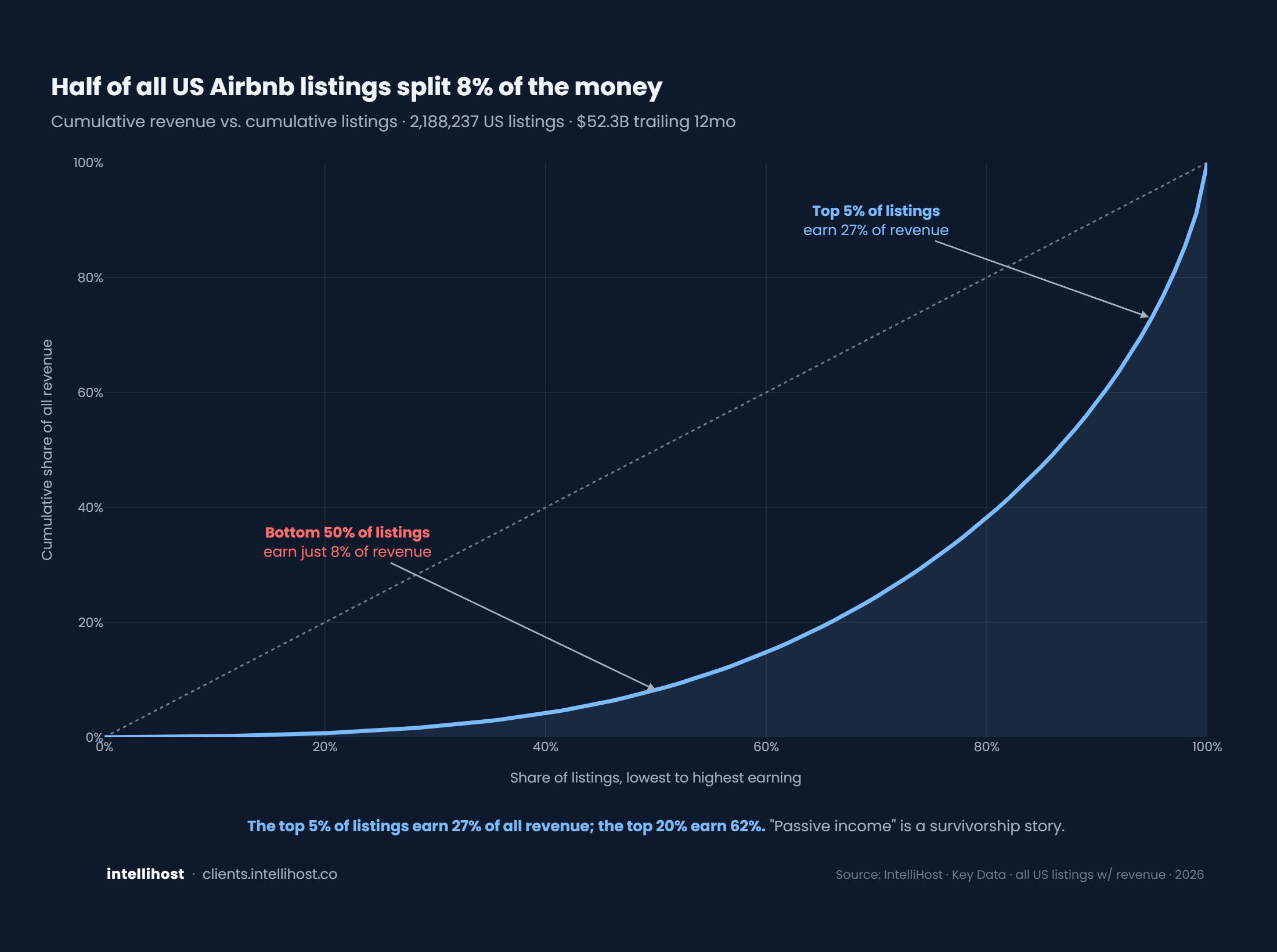
Top 5% earn 27%
Based on
2.2M US listings
Key finding: Across 2.2 million US Airbnb listings, the top 5% of properties earn 27% of all revenue.
The short version
Airbnb revenue is not spread evenly. A small slice of listings takes home most of the money, and the bottom half of the market splits scraps. If you run short-term rentals, this tells you the real competition is not the platform or the neighborhood. It is the operators who show up and run their listings better every single day.
The data
Looking across 2.2 million US listings, the pattern is steep and consistent:
- The top 5% of listings earn 27% of all revenue.
- The top 1% earn 8.9% of all revenue.
- The top 10% earn 41.6% of all revenue.
- The bottom half of all listings earn just 8.2% combined.
Those are the only numbers here, and they are enough. A handful of listings carry the market while half of everyone else fights over a sliver.
Why it works
Revenue on Airbnb compounds. A listing that ranks well gets more views, which brings more bookings, which brings more reviews, which lifts ranking again. The winners are not sitting on secret real estate. They price to demand, keep their calendars open and current, answer guests fast, and refresh photos and titles when the market shifts. Each small habit feeds the next. Over a year, that gap between an actively managed listing and a set-and-forget one turns into the spread you see in the data.
What to actually do
- Price to real demand. Move your rates with the season, the day of week, and how far out the calendar is, instead of leaving a flat nightly rate up all year.
- Fix the fundamentals that drive ranking. Sharpen your title, lead with your best photos, and keep your availability open and accurate so the algorithm keeps showing you.
- Treat it like an operation, not a mailbox. Reply to inquiries quickly, ask for reviews, and check your listing against similar homes nearby on a regular schedule.
The honest caveats
This is a correlational finding. The data shows that a small group of listings captures most of the revenue, but it does not prove that any single habit causes a listing to jump into the top tier. Location, property type, and market demand all matter and vary widely across 2.2 million listings. What the numbers do show clearly is the size of the gap. What they do not do is guarantee that copying the top operators moves any one listing a fixed amount. Treat the actions above as the levers you control, not a promise.
Methodology
The finding is based on 2.2 million US listings, drawn from IntelliHost and Key Data in 2026. Revenue share was measured by ranking listings from highest to lowest earning and calculating how much of the total pool each band captured. The top 1%, top 5%, top 10%, and bottom 50% figures come directly from that distribution. This is a market-wide view rather than a controlled comparison, so it describes how revenue is concentrated, not what any individual listing would earn under different management.
Frequently asked questions
Is Airbnb actually passive income?
For most listings, no. The top 5% of US listings earn 27% of all revenue while the bottom half earns just 8.2% combined, which means the results come from active operation, not from letting a listing sit.
How much of Airbnb revenue goes to the top listings?
The top 10% of listings earn 41.6% of all revenue, and the top 1% alone earn 8.9%. Revenue is heavily concentrated at the top of the market.
Can an average listing move into the top tier?
The data is correlational, so it cannot promise a specific jump. It does show that the top listings are the same asset class run better, which points to pricing, ranking fundamentals, and fast guest response as the levers worth pulling.