
Reviews
Which review subscore actually tracks revenue?
It isn't the one you scrub for.
Communication +10%
Based on
40,087 US listings
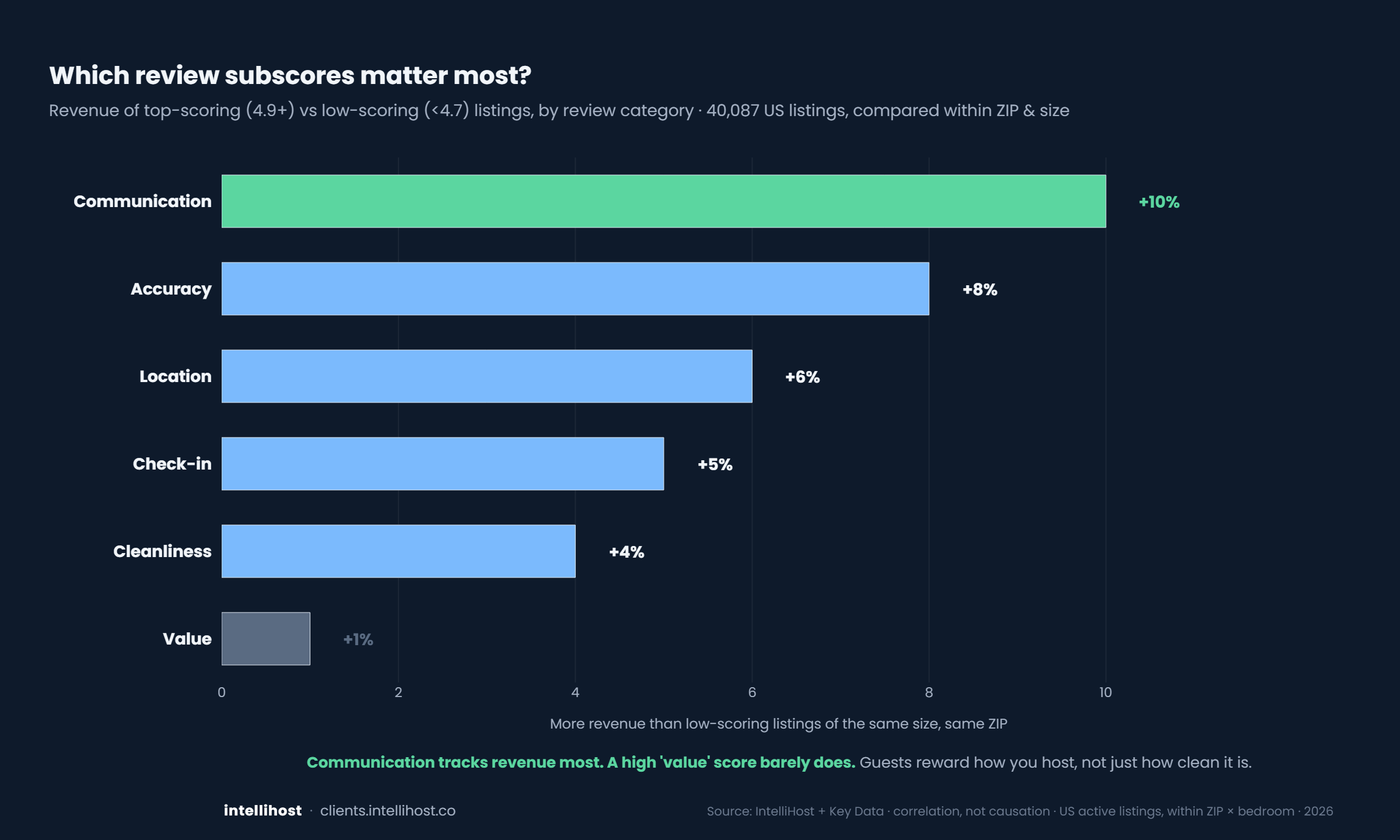
Key finding: Across 40,087 US listings, communication is the review subscore that tracks revenue hardest, with top-rated hosts earning about 10 percent more than bottom-rated hosts, while the value subscore barely moves the needle at roughly 1 percent.
The short version
Most hosts obsess over cleanliness and worry about their value score. The data says that energy is misplaced. Communication is where the money is, and value is the weakest signal of the six. A strong value score often just means you are underpriced, so chasing it can quietly cost you. If you want your review profile to line up with revenue, put your effort where the correlation is real.
The data
We looked at the six standard review categories and measured how each one lines up with revenue.
- Communication: about +10 percent revenue for top-scoring versus bottom-scoring listings. This is the strongest of the six.
- Value: about +1 percent. This is the weakest of the six.
Those are the two ends of the range. Communication tracks revenue hardest. Value comes dead last.
Why it works
Communication is a signal guests read before they book and feel again during the stay. Fast, clear replies reduce the friction that kills a booking and the confusion that sinks a review. It is also something you control directly, which means it responds to effort in a way that location or size never will. Value is different. A high value score frequently reflects a low price rather than a great stay, so it rewards you for leaving money on the table. That is why value looks strong to guests but weak against revenue.
What to actually do
- Treat communication as a revenue lever. Tighten your response time, use saved templates for common questions, and automate check-in and pre-arrival messages so nothing slips.
- Invest in accuracy alongside communication. Make your listing match reality so guests arrive with the right expectations, which protects both scores you control.
- Treat cleanliness as table stakes and stop over-optimizing value. Nearly everyone is already near-perfect on cleanliness, and a rising value score may just mean you are priced too low.
The honest caveats
This is a correlation, not proof of cause. We cannot say that raising your communication score by itself will lift revenue by 10 percent, only that listings with strong communication scores tend to earn more. The value finding is a good example of why direction matters: a high value score may reflect underpricing rather than a better guest experience. The sample is US listings, so results may differ in other markets. Use this to decide where to focus, not as a guarantee of a specific dollar outcome.
Methodology
The analysis covers 40,087 US listings, drawn from IntelliHost combined with Key Data in 2026. For each of the six review categories we compared revenue between top-scoring and bottom-scoring listings, holding comparisons within ZIP code and bedroom count so we were weighing similar properties against each other rather than mixing a studio in one city with a large home in another. The headline figures are the revenue gap between the top and bottom of each subscore.
Frequently asked questions
Which review subscore matters most for revenue?
Communication. Across 40,087 US listings, top communication scores line up with about 10 percent more revenue than the bottom, making it the strongest of the six categories.
Does a high value score help my revenue?
Barely. Value is the weakest subscore, tied to only about 1 percent more revenue, and a high value score often just means your listing is underpriced.
Should I stop caring about cleanliness?
No, but treat it as table stakes rather than a growth lever. Almost every listing already scores near-perfect on cleanliness, so it rarely separates you, whereas communication and accuracy are within your control and track revenue more closely.