
Reviews
How many reviews do you actually need?
About 30. Not 300.
~30 reviews
Based on
13,718 US listings
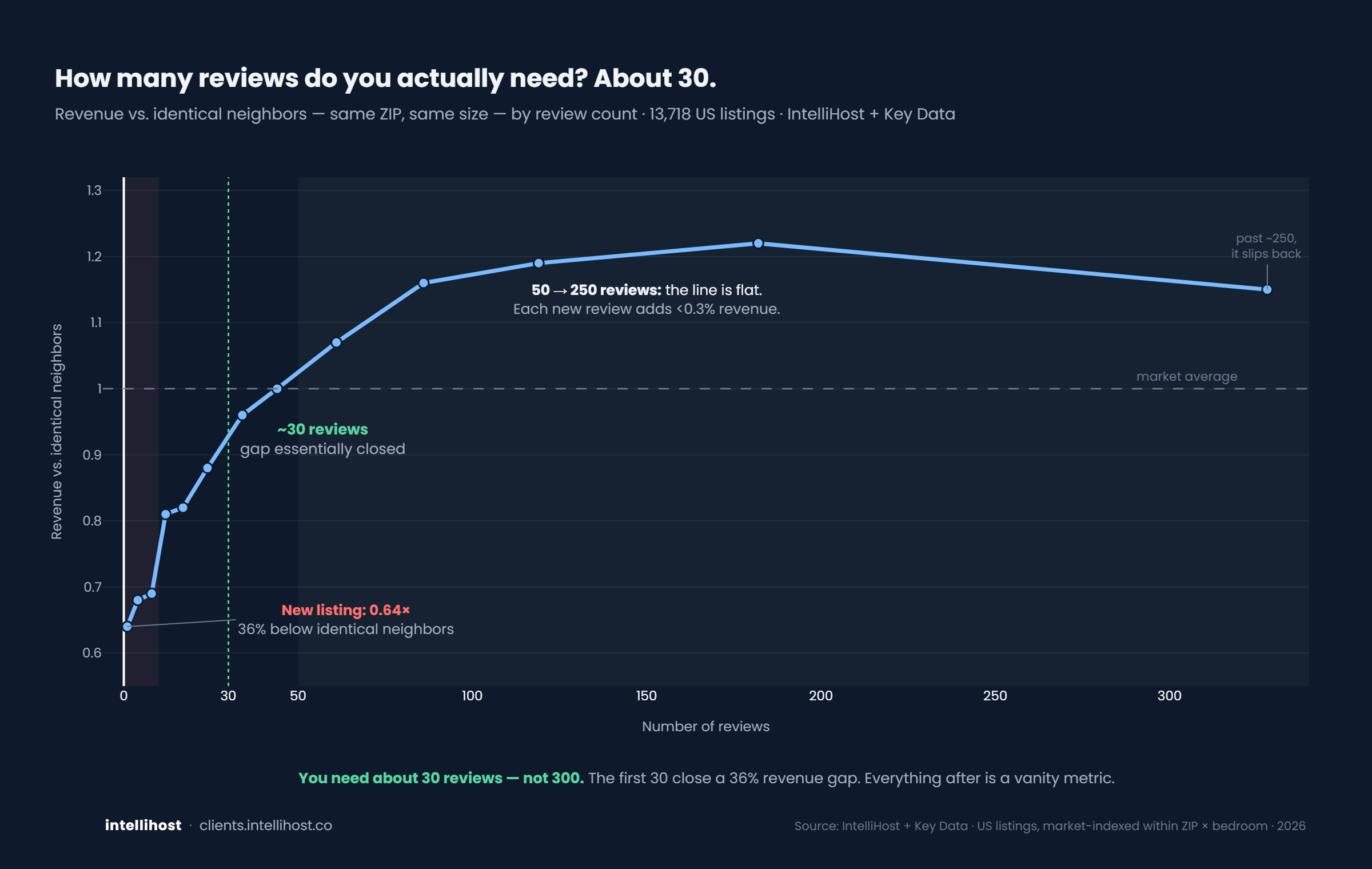
Key finding: Across 13,718 US listings, a new listing recovers nearly all of its revenue disadvantage by about 30 reviews. Not 300.
The short version
A brand-new listing earns roughly 64% of what an identical neighbor earns. That gap is real, and reviews are what close it. The good news for operators is that the finish line comes early. By about 30 reviews you have recovered almost all of the lost revenue, so the smart move is to sprint a new unit to 30 and then stop counting.
The data
Here is what the numbers say, and only what they say.
- A brand-new listing earns about 64% of what an identical neighbor earns.
- Reviews close that gap fast, and by roughly 30 reviews you have recovered nearly all of it.
- Past 50 reviews, each additional review adds under 0.3% to revenue.
That last point is the one most hosts miss. The reviews after 50 are not worthless, but they are close to it for revenue.
Why it works
A listing with no reviews asks a guest to take a leap of faith. There is no social proof, so the guest hesitates or picks a proven neighbor instead. The first handful of reviews remove that hesitation, and each early review carries a lot of weight because it moves the listing from unproven to trusted. Once a listing has enough reviews to look established, additional reviews stop changing the guest’s decision. The signal is already sent, so more of it barely moves revenue.
What to actually do
- Treat the first 30 reviews on a new unit as a launch project. Ask every guest, make the request easy, and follow up.
- Once a listing clears roughly 30 reviews, stop chasing review count on it. The revenue return has mostly been collected.
- Move your attention and your review push to the next new listing, where the same 30 reviews are worth far more.
The honest caveats
This is a correlational finding, not a controlled experiment. It shows that listings with more reviews earn more up to a point, not that adding a review directly causes a specific revenue gain. The comparison holds review-adjacent factors steady by looking within the same ZIP and the same bedroom count, but no observational study removes every difference between listings. Reviews also do more than drive revenue. They build trust, surface operational problems, and help with search placement, and none of that is captured by the revenue number alone.
Methodology
The analysis draws on IntelliHost and Key Data records for 13,718 US listings in 2026. Revenue was compared against similar listings within the same ZIP code and the same bedroom count, so a new unit is measured against near-identical neighbors rather than the market at large. Review counts were then mapped against that relative revenue to find where the gap closes and where added reviews stop paying off.
Frequently asked questions
How many reviews does a new Airbnb or vacation rental need?
About 30. Across 13,718 US listings, a new unit recovers nearly all of its revenue disadvantage by roughly 30 reviews, and reviews past 50 each add under 0.3% to revenue.
Do more reviews always mean more revenue?
Not in a way that matters past a point. Early reviews close most of the gap, but beyond about 50 reviews each additional one adds under 0.3% to revenue.
How much less does a brand-new listing earn?
A brand-new listing earns about 64% of what an identical neighbor earns. Reviews are the main thing that closes that gap, and most of it closes by around 30 reviews.